


 LATEST NEWS:
English
08.12.2025
 10:04:00
HOW TRUMP CAN STABILIZE BiH?

BANJA LUKA, DECEMBER 8 /SRNA/ - The administration of US President Donald Trump, with its engagement, could return BiH to its Dayton framework and base any subsequent solution on a political agreement and compromise of all constituent peoples, assessed international and economic policy expert Nemanja Plotan.
We are publishing Nemanja Plotan's column for SRNA in its entirety: For centuries, BiH has stood at the crossroads of empires and kingdoms - Ottoman, Austro-Hungarian, and Yugoslav - each attempting to forge a unified identity out of deeply divided communities. All these attempts, whether through imperial administration or ideological coercion, collapsed under the weight of unresolved traumas and conflicting national narratives. The historical lesson of BiH is therefore simple but essential: stability cannot be imposed from above or from the outside — it must emerge from mutual political recognition among all three constituent peoples. Major conflicts have struck BiH roughly every four decades, always at moments when the global geopolitical order was shifting. It has now been 30 years since the signing of the Dayton Agreement, which ended the civil war, and it is no surprise that renewed regional and international interest in BiH is growing. Today, as we witness a transformation of the global order, a political vacuum has emerged in BiH - a vacuum that destabilizes the country, which has been created by Western bureaucratic intervention. A series of externally imposed political decisions has awakened historical traumas across all communities in the Western Balkans. The greatest mistake of the political West in the Balkans was the belief that history can simply be forgotten and that coexistence can be manufactured through institutional engineering rather than genuine compromise. As a result, Serbs and Croats have been systematically pushed into political arrangements that deviate from the very document upon which BiH was founded - the Dayton Peace Agreement. The core political dispute in Bosnia and Herzegovina lies in the interpretation and implementation of Dayton. The Office of the High Representative /OHR/, whose formal role was to supervise the "civil implementation" of the agreement, has used the Bonn Powers to reshape the country’s political landscape according to its own preferences. Since the Bonn Conference in 1997, High Representatives have imposed more than 900 decisions and over 400 laws without the consent of democratically elected institutions. These interventions consistently favored the political interests of the Bosniak side at the expense of Serbs and Croats, undermining trust in institutions and eroding the democratic legitimacy of the state. Instead of serving as a temporary supervisory mechanism, the OHR evolved into a form of international tutelage - a modern protectorate governed not by the citizens of BiH but by an unelected foreign official. By ignoring the weight of collective memory and the significance of historical experience, Western officials deepened the very divisions they claimed to be trying to overcome. Their attempts to promote a unitary, civic-based BiH included efforts to dilute or eliminate the political autonomy of Republika Srpska - leaving its institutional structure intact, but stripping it of its political essence. History clearly shows that whenever Serbs were deprived of political autonomy, it led to mass persecution, killings, and the erosion of their cultural and national identity. Republika Srpska emerged during the dissolution of Yugoslavia precisely as an effort to prevent the repetition of genocidal crimes committed against the Serbian people in the territory of the Nazi-aligned Independent State of Croatia /NDH/. For this reason, a unitary BiH has always been politically unacceptable to Serbs. Because the weight of this collective historical trauma was never properly acknowledged in Western capitals, Serbs were often portrayed as a destabilizing factor rather than as a people defending their historical right to political equality and autonomy. The more Serbian representatives tried to explain the region's complexities to Brussels, London, and Washington, the louder the bureaucratic calls became to "move beyond the past". As a result of this disregard for historical context, Western policymakers failed to create any sustainable political model for BiH and left the country in a state of permanent political crisis. Trump's approach, unlike that of his predecessors, starts from the recognition that reconciliation cannot be built on denying reality. It requires acknowledging the political structure of the region and engaging its leaders as equal partners rather than treating the Balkans as a laboratory for social experiments. The decision of the US administration to lift sanctions on President Milorad Dodik and the leadership of Republika Srpska signals that American foreign policy is finally adapting to the historical lessons that have shaped the Balkans. The Trump administration does not view the Balkans through the lens of moral grandstanding but through the logic of interests. Trump sees the world transactionally - states cooperate when it benefits both sides. Although idealists criticize this worldview, it is precisely such pragmatism that BiH has been lacking - a break from liberal nation-building and a return to realistic engagement. With such an approach, the Trump administration could restore BiH to its original Dayton framework and ensure that any future solutions are based on political agreement and compromise among all three constituent peoples. Although Bosniaks, Serbs, and Croats rarely find common ground on political issues, trade and economic cooperation have repeatedly opened space for compromise. This is why Trump could address the political crisis through robust economic initiatives. Economic cooperation, investment, and energy interconnection provide far more durable foundations for peace than externally imposed political solutions that have dominated the post-Dayton era. The negotiating table becomes far more appealing to all three peoples when it includes initiatives that satisfy everyone's economic interests - provided that the old rule is respected: "during lunch, politics stays off the table". Once economic needs are met, the space for political agreements naturally widens.
English
14 minutes from now
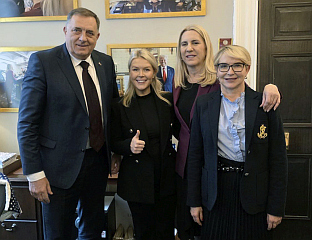
DODIK AT WHITE HOUSE, TRUMP’S POLICY BRINGS NEW STABILITY TO GLOBAL RELATIONS
WASHINGTON, FEBRUARY 6 /SRNA/ – SNSD leader Milorad Dodik, the Serb BiH Presidency Željka Cvijanović, and the acting President of Republika Srpska Ana...
6 minutes ago

PAOLA MAGONI ON JAHORINA, 42 YEARS AFTER OLYMPIC GOLD
JAHORINA, FEBRUARY 6 /SRNA/ – Italian skier Paola Magoni skied today on the Olympic track “Olympic” on Mount Jahorina, where she won a gold medal 42 y...
1 hour ago
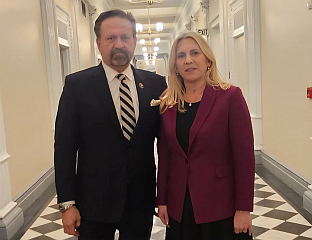
CVIJANOVIĆ MEETS WITH SENIOR DIRECTOR FOR COUNTERTERRORISM AT THE WHITE HOUSE
WASHINGTON, FEBRUARY 6 /SRNA/ – The Serb BiH Presidency member, Željka Cvijanović, held talks today at the White House with Sebastian Gorka, Senior Di...
1 hour ago

PATIENT FROM SERBIA FIRST IN THE WORLD TO GET RUSSIAN CANCER VACCINE
BELGRADE, FEBRUARY 6 /SRNA/ – A patient from Serbia, Jovana Aleksić, who has melanoma, a skin cancer with metastases, will be the first person in the...
2 hours ago
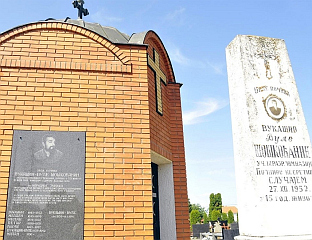
MEMORIAL DEDICATED TO VUKAŠIN ŠOŠKOČANIN, COMMANDER OF BOROVO SELO DEFENCE, REMOVED
BOROVO, FEBRUARY 6 /SRNA/ – Croatian authorities have removed the chapel dedicated to Vukašin Šoškočanin, commander of the Borovo Selo defence, after...
2 hours ago
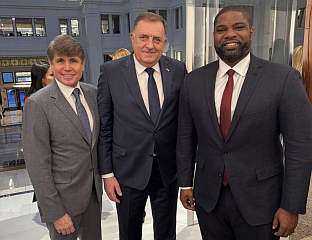
DODIK MEETS WITH TRUMP’S CANDIDATE FOR GOVERNOR OF FLORIDA
WASHINGTON, FEBRUARY 6 /SRNA/ – SNSD leader Milorad Dodik has met today with Byron Donalds, Donald Trump’s candidate for Governor of Florida, and shar...