


 LATEST NEWS:
English
27.12.2025
 10:47:00
MEMORIAL SERVICE FOR SERBS KILLED ON CHRISTMAS IN KRAVICA ON JANUARY 5
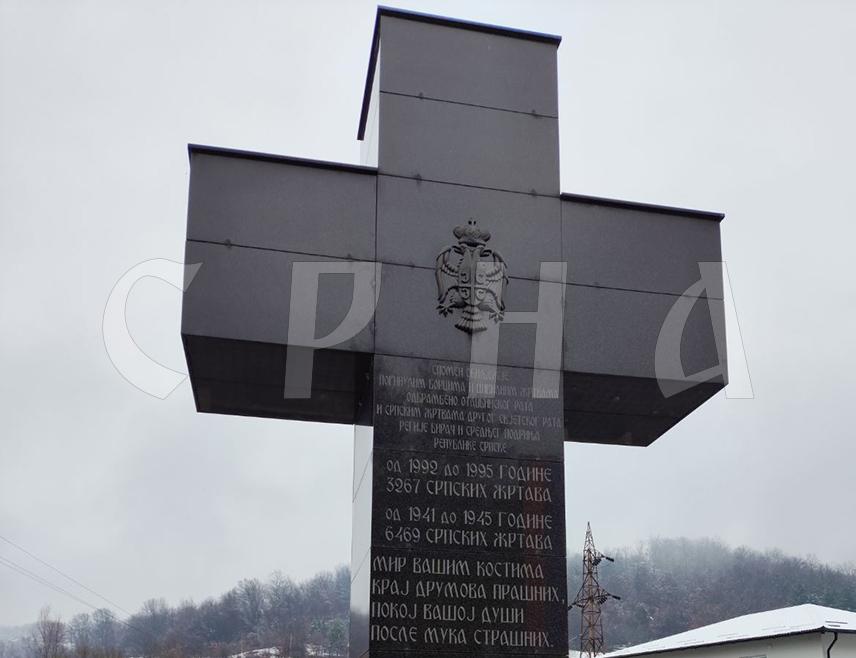
BRATUNAC, DECEMBER 27 /SRNA/ – A memorial service for 49 Serbs from Kravica and its hamlets who were killed on Orthodox Christmas in 1993 will be held on January 5, marking 33 years since that major tragedy, Zoran Gvozdenović, the head of the Bratunac Municipal War Veterans Organisation, told SRNA.
Gvozdenović says the service will also commemorate 163 Serbs from Kravica and neighbouring hamlets who lost their lives during the Defensive-Patriotic War, 49 of whom were killed on January 7, 1993, by Muslim forces from Srebrenica under the command of Naser Orić. He says the memorial service will be held at 11:00, and at 11:45 a tribute and wreath-laying ceremony will take place at the memorial cross in Kravica for 3,267 fallen Serb civilians and soldiers from the Central Podrinje and Birač regions. Kravica was liberated two months after the crime against its population, and only then were the bodies of Serb victims discovered and identified in yards, fields, and streams, after which they were buried. Ethnic cleansing in the Central Podrinje began in April 1992 with the destruction of everything carrying Serb prefix. Muslim forces from Srebrenica, under the command of Naser Orić with assistance from units from the Bratunac, Vlasenica, and Zvornik areas, continued persecution, killings, and destruction of Serb population and property throughout 1992 and early 1993. After numerous crimes committed in Serb villages around Srebrenica and Bratunac in the first year of the civil war in BiH, Orić’s units continued attacks in 1993, when on Orthodox Christmas they entered Kravica, killing 49 residents and wounding another 80. Seven people went missing, five of whom have still not been found 33 years later. Among those missing that day were two women. On Christmas Day the village was looted, 688 Serb-owned houses were burned in the wider Kravica area. About 2,000 auxiliary buildings and 27 public facilities were destroyed. Around 1,000 residents were left homeless in a single day and fled through deep snow toward the Drina River, escaping certain death by crossing into Serbia. As many as 101 children were left without one or both parents. From the beginning of the war until mid-1995, Muslim forces from Srebrenica repeatedly carried out raids on Serb villages around Srebrenica, Bratunac, Milići, Skelani, and Zvornik, killing residents, looting, and burning Serb-owned property. Captured Serbs were subjected to severe abuse, massacred, beheaded; there were cases of Nenad Rankić being roasted on a spit and of Anđelko Mlađenović's head being cut off and kicked like a ball in Srebrenica, showing the children to see "what a Chetnik's head looks like". This practice did not cease even after Srebrenica was declared a UN “safe area” in April 1993. Of about fifty Serbs who remained in Srebrenica at the beginning of the war being loyal to the then Muslim authorities, only one elderly woman survived. Another elderly woman, Ivanka Mirković, was found with her throat slit in July 1995 near her home close to a police station that had served as a camp for Serbs during the war. Mirković was witnessing the torture and suffering, listening to the cries of Serb inmates who were beaten by Muslim soldiers. She was slaughtered by the villains while escaping from Srebrenica so that she would not testify about those tortures Most of the missing have still not been found or exhumed, while no one has been held accountable for their fate. At the very beginning of the war, units under Naser Orić command expelled and killed the Serb population from Srebrenica and nearby villages such as Dugo Polje, Pećišta, Kovačice, Gostilj, Gniona, Osredak, Viogor, Studenac and others. Detention camps for Serbs were established. A unique example is the "chicken coop" camp in Gornji Potočari, where all the inhabitants of the Serb village of Čumavići, who were captured, were imprisoned; they were civilians. Later, several more camps were formed in Srebrenica and the surrounding villages where captured Serbs were tortured and killed. Several such camps later operated in Srebrenica and surrounding villages, where captured Serbs were abused and killed, who at the beginning of the war remained loyal to the then Muslim government, but did not survive the torture and live to see freedom After the destruction of Serb villages closest to Srebrenica, attacks extended to more distant villages in the Srebrenica and Bratunac areas - Ratkovići, Karno, Krnjići, Brežani, Magašići, Zagoni, Zalazje, Sase, Biljača, Fakovići, Bjelovac, Sikirić, Podravanje, culminating in the Kravica massacre on January 7, 1993, and in Skelani nine days later. In those two places, a total of 114 Serbs were killed, about 70 percent of whom were civilians. After Srebrenica was declared a UN protected zone, instead of demilitarization, raids from the enclave into Serb villages continued. With the exception of three villages along the Drina River, all Srebrenica villages and more than 100 villages in the Bratunac and Milići municipalities were destroyed and units under Naser Orić killed around 3,000 Serbs, more than half of whom were civilians. Attacks most often took place on major Orthodox holidays, such as Christmas, St. Peter’s Day, St. George’s Day, St. Vitus Day, and others. The villains did not leave alive even the sick and immobile, women, children and the elderly, while the captives were dying after brutal torture. They did not leave anyone alive anywhere. The same happened in Kravica. Two days after the massacre, seven bodies were found and buried, while another 42 bodies were discovered and buried two and a half months later. According to testimonies of surviving residents, many Bosniaks who later returned to the Srebrenica and Bratunac areas participated in the attack on Kravica. Even 33 years later, no one has been held accountable for the killings and crimes in Kravica or in many other Serb villages in Central Podrinje region, except for two individuals convicted for three isolated murders in the Bratunac area. According to survivors’ accounts and historical data, the Christmas attack on Kravica was seen as a continuation of a crime committed during World War II in 1944, when dozens of Serb civilians were killed in a nearby village. No one was held accountable for that crime either. The Christmas attack on Kravica, according to thesurvivors accounts and historical data, was a continuation of the Ustasha crime committed on St. Vitus Day in 1944, when the Ustasha from the surrounding villages set fire to 38 Serb residents in the basement of a house in the village of Zonići near Kravica. One-year-old Jefa and 64-year-old Pavle and Vasilije Pavlović were among those set on fire. No one was held accountable for that crime; driven by that knowledge, the descendants of the butchers from the Second World War committed a new crime, believing that no one would be held accountable again, which, unfortunately, came true.
English
7 hours ago
DODIK: CYNICAL CRIMINALS DID HUGE HISTORICAL INJUSTICE AGAINST SERBS
VRANJE, MARCH 24 /SRNA/ – The policy of Republika Srpska and Serbia must remain military neutral without NATO membership, given that NATO bombs target...
8 hours ago
PATRIARCH PORFIRIJE: NATO AGGRESSION ONE OF SERB PEOPLE’S LAST GOLGOTHAS
VRANJE, MARCH 24 /SRNA/ – His Holiness Patriarch Porfirije of Serbia has said this evening in Vranje that the 1999 NATO aggression was one of the last...
13 hours ago
REPUBLIKA SRPSKA NATIONAL TEAM WINS NINE EUROPEAN MEDALS IN CRETE
BANJA LUKA, MARCH 24 /SRNA/ – The national jiu-jitsu team of Republika Srpska achieved a historic success at the European Championship in Crete, winni...
13 hours ago
PETROVIĆ: ENERGY SUMMIT THE MOST AUTHORITATIVE EVENT
TREBINJE, MARCH 24 /SRNA/ - The Energy Summit in Trebinje /SET/ is the most authoritative gathering in the field of energy, and the positions that wil...
14 hours ago
RECIPROCAL MEASURES IF CROATIA CONTINUES DETAINING SRPSKA'S CITIZENS
BANJA LUKA, MARCH 24 /SRNA/ - SNSD leader Milorad Dodik said that he will not allow people from Republika Srpska to be victims of political and ideolo...
15 hours ago

DODIK: SUPPLEMENTS TO BiH LAW ON EXCISE DUTIES WILL NOT BE ADOPTED
BANJA LUKA, MARCH 24 /SRNA/ - The bill supplementing the Law on Excise Duties in BiH will not be adopted at the BiH level, as the original revenues fr...