


 LATEST NEWS:
English
14.04.2026
 10:02:00
PLOTAN: CENTRAL BANKS WILL OVERCOME GEOPOLITICAL CHALLENGES IF THEY LEARN TO PLAY "RISK"
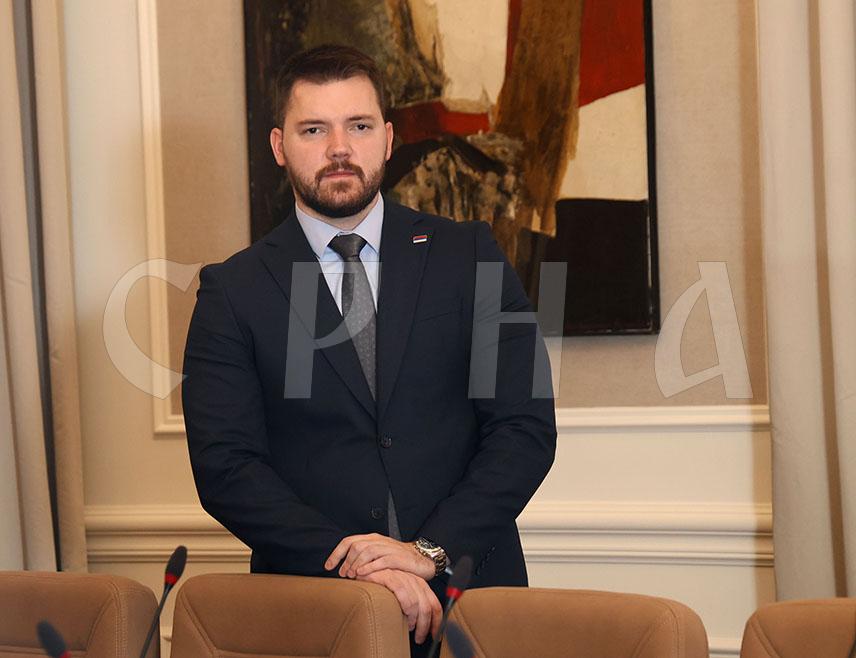
BANJA LUKA, APRIL 14 /SRNA/ - In order to avoid similar economic episodes in the future, as it was the one in 2008, central bankers should be encouraged to think outside the dominant school of economic thought, and war simulations are one of the possible intellectual pathways, international and economic policy expert Nemanja Plotan assessed.
"Imagine you are an economist at a central bank. Instead of staring at Excel spreadsheets and complex econometric models, you are looking at a world map with plastic tanks on it, dice in your hand. In front of you is the map from the popular board game `Risk,` only adapted to real-world circumstances. However, your goal is not to conquer the world and become the next Napoleon, but to maintain the stability of the national economy while the entire board is shaking. Besides being a fun `team-building` activity, this could very easily be the future of monetary policy," Plotan stated in a column that SRNA publishes in its entirety: Traditional macroeconomic models analyze an almost perfectly ordered world, which the real world certainly is not. Geopolitical shocks now transmit to financial markets and the real economy in just a few minutes - while the full effect of monetary policy still arrives on average only after 18 months. From the war in Ukraine, through the rivalry between the US and China, to the imposition of new sanctions - global geopolitical challenges show that national economies behave less like textbook examples and more like adversaries in a strategic game. Perhaps central bankers should borrow a page or two from the military and try their hand at war simulations. Just as the military plays simulations to prepare for war, central banks could play games to prepare for external shocks, market disruptions, and economic downturns in periods of high geopolitical uncertainty. We are all familiar with the board game "Risk". War simulations are actually very similar. They involve a map, a real-life scenario, two or more players, a set of rules, real-world objectives, and dice that introduce an element of randomness. The UK Ministry of Defence defines war simulations as "a decision-making technique that provides a structured but intellectually liberating environment in which it is safe to fail, in order to test what works and what does not — usually at a relatively low cost". In the 1960s, the Pentagon conducted a series of classified simulations known as "Sigma I-64" and "Sigma II-64" to predict the outcome of American military involvement in Vietnam. The results of the simulations showed, among other things, that even half a million American troops would not secure victory, that air power would have limited strategic impact, and that public opinion would turn sharply against the war. Since the simulations predicted almost all the outcomes of the war with striking accuracy, H.R. McMaster described them as “eerily prophetic.” War simulations are obviously not a crystal ball and certainly cannot tell central banks by how many basis points they should change interest rates. But what they can achieve effectively is to break the limitations of conventional economic models and force decision-makers to confront uncomfortable, high-impact possibilities. Some institutions have already begun experimenting with structured strategic simulations. The European Central Bank uses scenario-based horizon scanning, the Federal Reserve occasionally conducts geopolitical risk tests, and the Bank of England analyzes domino effects of risk. However, these exercises are limited and often disconnected from the core processes of policy formation. A more ambitious approach would be to integrate war simulations into regular monetary policy discussions, similar to how the military incorporates so-called "red team" analysis into every major operation. War simulations conducted by central banks could bring together economists, strategists, diplomats, and technologists in the same room to discuss different policy options. In a multipolar world, where monetary policy increasingly intersects with geo-economics and security, a war simulations approach would force monetary policymakers to consider how possible spiral effects of sanctions, disruptions of maritime routes, election shocks, or interruptions of global supply chains transmit to financial markets and the real economy. War simulations would not only inform central banks about possible geopolitical developments but would also offer proposals for conventional and unconventional monetary responses. In November 2008, during a visit to the London School of Economics, Queen Elizabeth II asked economists: "Why did nobody see it coming?", referring to the 2008 financial crisis. A few months later, the British Academy sent her a formal letter with the answer. It stated that the crisis occurred due to "a failure of the collective imagination of many bright people". To avoid similar economic episodes in the future, central bankers should be encouraged to think outside the dominant school of economic thought, and war simulations are one of the possible intellectual pathways. The Central Bank of BiH /CBBiH/ and the National Bank of Serbia /NBS/ already include geopolitical risks in their regular analyses, as they have been taught painful lessons from the hyperinflation of the 1990s. However, moving toward more ambitious war simulations - which would bring together economists, diplomats, energy experts, and security specialists - would allow them to go one step further. Teams from the CBBiH and the NBS could, in one simulation, play out a scenario in which there is a sudden disruption in the supply of energy sources from Russia or the Middle East, accompanied by new sanctions. In such a game, it would become clear how quickly inflation expectations can de-anchor, how foreign exchange reserves react under pressure, and which combined responses /conventional interest rates, macroprudential measures, or unconventional interventions/ would be most effective before the shock becomes uncontrollable. In this way, weak points would be identified in advance and protocols prepared that are currently lacking. War simulations are not a guarantee of perfect decisions, but they are a powerful tool to avoid repeating historical mistakes and to finally awaken the collective imagination of economists.
English
1 hour ago
DODIK: IZETBEGOVIĆ OFFERED EXCUSES BUT NO CLARIFICATION OF HIS STATEMENT DURING PHONE CALL
BANJA LUKA, JUNE 24 /SRNA/ – SNSD leader Milorad Dodik said that Bakir Izetbegović failed at any point during a telephone conversation to explain the...
2 hours ago
SAVIĆ: IZETBEGOVIĆ'S RHETORIC IS UNDERMINING AND DANGEROUS
BIJELJINA, JUNE 24 /SRNA/ – Bojan Savić, president of the SNSD City Board in Bijeljina, said that SDA leader Bakir Izetbegović`s remarks about SNSD Pr...
2 hours ago
JAVOR: BAKIR'S SUPPORT REVEALS TRUE PURPOSE OF THE SARAJEVO DOCUMENT
PRIJEDOR, JUNE 24 /SRNA/ – Prijedor Mayor Slobodan Javor said it is interesting that Bakir Izetbegović has been publicly praising a document signed in...
3 hours ago
IZETBEGOVIĆ CONFIRMS DODIK’S ROLE AS DEFENDER OF REPUBLIKA SRPSKA
ISTOČNO SARAJEVO, JUNE 24 /SRNA/ – Milorad Kojić, an SNSD member of the House of Representatives of the BiH Parliamentary Assembly, told SRNA that SDA...
3 hours ago
CRNKOVIĆ: CROATIA IGNORES THAT TRGOVSKA GORA PROJECT DISREGARDS CITIZENS' CONCERNS
ZAGREB, JUNE 24 /SRNA/ – Mario Crnković, president of the Green Team association from Novi Grad, believes that keeping the Trgovska Gora issue in the...
3 hours ago
ŠKIPINA: BAKIR PROMISED THEM POWER, BUT NOT THROUGH THE PEOPLE’S VOTES - RATHER THROUGH FORCE FROM SARAJEVO
PALE, JUNE 24 /SRNA/ - If someone had any doubts until now about the true political platform of Draško Stanivuković and Branko Blanuša, after the Sara...